

Discourse Piggybacking
And other reflections on the default culture of reiterative commentary

The following text I originally posted on Notes, as a response to this article by sabine carys:

As I’m still working on my next full post, and I though this had some interesting ideas (which a few people have commented on), I thought I’d share it with you all.
This article astutely put into words a phenomenon that is sadly highly prevalent on Substack, and is part of the broader downside of contemporary Internet culture. The framing of the “reactive essay” - the practice of commentary on commentary - is a result of the way digital media has come to shape the content, organisational flow and value of knowledge.
Substack, if anything, is just one of the cleaner interfaces for a deeper logic that we have come to accept the default information apparatus: attention as a currency, circular immediacy of superficial “hot takes”, and discourse as a trend to be jumped on for content production.
There is an unfathomably large number of YouTube channels and podcasts whose raison d’être is to address, not the event or story itself, but the reactions to reactions. So much of independent “news” media is essentially this, and as you suggest, along with celebrity gossip shows, and sports commentary and in TV and Film.
I have to admit I’ve fallen down the rabbit hole of watching young musicians and fans reacting to classic rock and pop from the late 20th century. This is a harmless but fascinating trend because, at its best, it reflects an openness to engaging with cultural forms one is not familiar with. The opposite of the tyranny of tribal fandom is so prevalent as a result of digital ecosystems.
And it’s not even that “reaction” is inherently trivial. Cultural criticism, in the most direct sense, is a form of identifying what is at stake in a work: what it thinks it’s doing, what it’s doing, what it reveals about the world that produced it, and what it makes newly visible to us as viewers.
But the internet did something quite specific: it didn’t just multiply the number of voices. It multiplied the number of interfaces for voicing, and then built reward systems around speed, repetition, and recognisable prompts.
The piece reminded me of how many aspects of “media” have shifted over the last quarter of a century and how, in 2026, we seem so far away from the utopian possibilities of the “democratisation of information” and the collapse of gatekeepers. Notions that were all the rage at the beginning of the “information age” (remember that term?)
While that is true in theory, it seems obvious that the mechanisms of the internet, specifically since the rise of social media, have ruptured the hierarchies, the free flow of information, or expanded creative possibilities, only within the framework of a content-driven “customisation of thought”.
A brief philosophical link that’s useful here is Deleuze’s short text on “societies of control”, where power works less like a gate you either pass through or don’t, and more like a continuous modulation which is softly adaptive, personalised, always-on. Under that model, the new gatekeeper isn’t a human editor; it’s the ambient logic of the feed: what gets surfaced, what gets reinforced and then what gets rewarded. Not censorship, exactly. Something more insinuating in terms of patterned repetition.
If you’re not already a subscriber, please consider doing so by hitting the button below. Also, I know you’re asked every time, but please be a wing-person in the deathly algorithm wars by liking, restacking, or even sharing to your other social media networks.
Human recommendations are the platinum currency of the digital attention economy.
There’s always an unease in asking for financial support, especially when one is competing in today’s oversaturated digital market. But if you can afford it and find value in the writing and resources here, please consider a subscription:
FOR THE WHOLE OF FEBRUARY, I’M OFFERING A ONE-MONTH FREE TRIAL. IF YOU WANT TO TAKE ADVANTAGE OF THIS, MESSAGE ME AT drdario22@gmail.com AND I’LL SET THAT UP.
You gain access to the full range of articles, podcasts, and film resources I produce. I’ll also send you a physical postcard, wherever you may reside:
Or, if you don’t want to subscribe but think to yourself: “yeah, I’d shout that guy a coffee if we ever met IRL”, you can do that here:
For paid subscribers, below I trace my unstable calculus behind seat selection: one cinephile’s pedantic, futile negotiation with space, body, and the presence of others, ever in search of the ideal cinematic experience.
This is not exactly anything new. Debord’s Society of the Spectacle (life mediated into representation, then representation consumed as life) is making something of a return, I’ve noticed. Baudrillard’s Simulations (copies without originals; signs circulating for their own sake) are obviously a post-modernist lineage for this.
None of that is a neat one-to-one mapping onto Substack. But it does give us a language for why “discourse piggybacking” feels so structurally sticky. Your piece names this perfectly when you describe the “ouroboros of commentary” and the way the original event “shrinks into the background.”
I agree to a large degree with the contention that “death of media can’t simply be attributed to AI or decreased attention spans, but this drift into recursive commentary.” This brought to mind the AI video of Brad Pitt and Tom Cruise in a fight sequence.
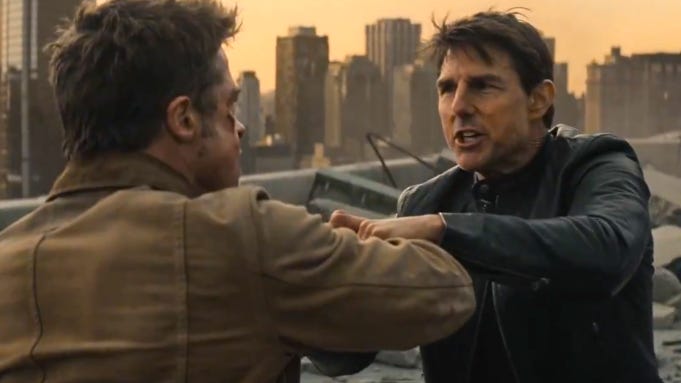
That clip is basically the whole economy in reaction miniature: familiar faces, recognisable affect, instantly legible “content”, and a kind of hollow pleasure that travels well because it asks almost nothing of you. The two avatars trading blows is visually symbolic of the circular discourse: representation detached from any original stakes, locked into a loop that generates “engagement” by endlessly re-performing itself.
What was also fascinating with AI is that it’s treated as the origin of the problem rather than its accelerant. AI is good at pastiche, synthesis, pattern recognition, and recombination of familiar iconographies tweaked into slightly new contexts. If our cultural sphere is already leaning toward iterative sameness, takes on takes, then AI simply makes the production of those iterations cheaper, faster, and more abundant.
Yet it still relies on the human prompter to decide how the content and context of creation. Reiteration is the easiest creative option, and the one most likely to garner the most views.
I enjoy writing on Substack. It has brought me into a community of people who share interests and sensibilities, which is obviously one of the true benefits of digital media. But it’s also disheartening to see just how “discourse piggybacking” is the bedrock of cultural writing.
Don’t get me wrong, I’m as guilty as anyone. One of my most successful pieces was on the reactive discourse to One Battle After Another (although I did try to take on the wider questions of Ideology v Aesthetics). I wrote this with a fair amount of calculation as to hot-topic-ness.
It’s certainly true that independent writers do not have the resources of a legacy publication, which can afford expansive interviews or in-person reportage. And you’re right to locate this as an economic and infrastructural issue as much as an aesthetic one: independent writing often runs on time scarcity, money scarcity, and energy scarcity.
I see that everywhere in the film writing on Substack (my area). Oscar speculation and Wuthering Heights hatefests are the watercooler subjects, but it does seem that we have fallen into a cultural apparatus which rewards the repetitive rather than intellectually expansive, truly thoughtful, or indeed, politically urgent.
I agree with the assertion that the smartest writers can use a familiar, of-the-moment hot take as a primer for something more in-depth or introspective. The problem, though, is that the patience and thought required for that “something more” is precisely what our digital experience is training us out of. From both a writer and a reader perspective.
For the writer: the constant low-grade anxiety that you’re late, that the moment has passed, that the discourse has moved on. The pressure to publish before you’ve cognitively metabolised the thing you’re responding to. For the reader: the learned habit of consuming the familiar, through formulas that minimise effort and maximise legibility. And then, of course, the media platforms are designed to manifest attention deficit and make the labour of the new and difficult feel arduously tiresome.
If I can be so bold, perhaps the question isn’t “is the reactive essay killing writing?” so much as: what kind of writing can survive under conditions where the reward system is calibrated for speed, recognisability, and constant replenishment?
“Reiteration is the easiest creative option, and the one most likely to garner the most views.”
Thank you! The algorithm and reward system birthing this type of discourse can make substack feel like an ecochamber but this is what keeps me here